

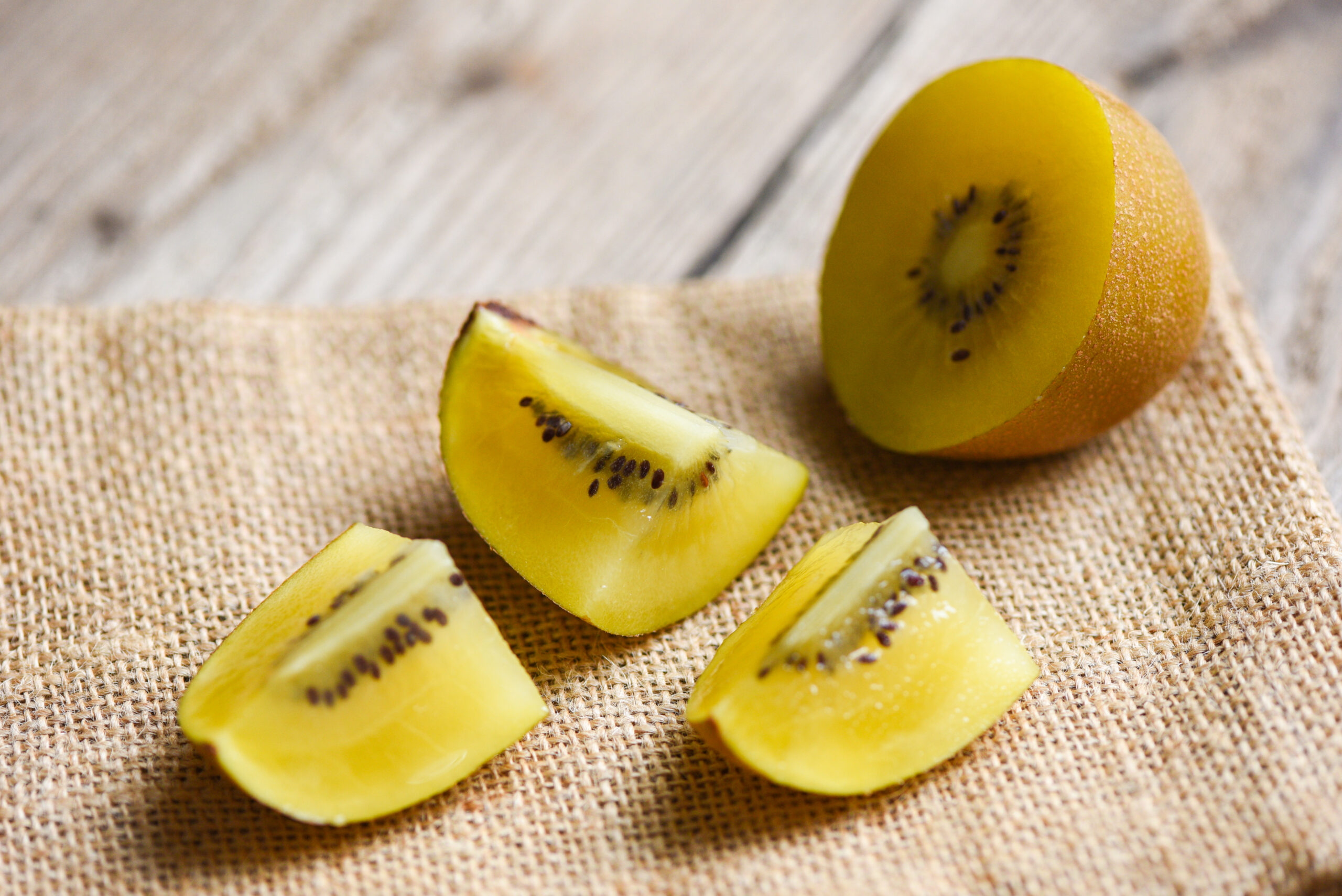
Written by Jessica Patella, ND. The study results indicate vitamin C blood concentrations increased in the participants, along with improvement in mental health measures after consuming SunGold kiwi fruit.
 Mental health disorders are in the top ten leading causes of disease burden worldwide, with an estimated 27.6% increase in depression post-COVID-19.1-3 The World Health Organization has called for lifestyle-based interventions as a first-line approach to mental health conditions.1,4 This led to research on SunGold kiwifruit, due to its high concentration of vitamin C. This crossover study in adults with mild to moderate mood disturbances showed improved mental health with consuming SunGold kiwi daily for 4-weeks.1
Vitamin C is a water-soluble vitamin that the body cannot make and therefore, it is necessary to obtain it through the diet. Vitamin C is highly concentrated in the brain and thought to play a role in forming necessary neurotransmitters in the brain (serotonin, dopamine, oxytocin) related to mental health.1,5 Suboptimal (<50 micromol/L) and deficient (<10 micromol/L) levels of vitamin C in blood have been associated with fatigue, irritability and low mood.1,6
There are two main types of kiwifruit: green and SunGold. Green kiwifruit contains about 88 mg of vitamin C, and SunGold kiwifruit contains about 152 mg of vitamin C per 100g of flesh fruit.1,7 SunGold kiwifruit contains a higher level of vitamin C per 100 g of fruit than green kiwi (88 mg), oranges (52 mg), strawberries (46 mg) or pineapple (21 mg), which explains why SunGold Kiwifruit was chosen for its potential effects on low mood for the study.1
Adults (n=26), 18-60 years of age, with mild-to-moderate mood disturbances were randomized to either 2 SunGold kiwifruit per day or their usual diet. There was a two-week washout period, then participants were crossed over to the opposite group.
After 4 weeks of consuming 2 SunGold kiwifruit per day (without skin), the following was observed in the kiwi group compared to the usual diet:
- A 65.2% improvement in total mood disturbance (p<0.001; Profile of Mood States Short Form, baseline 27.6 +/- 13.5 to week-4 9.6 +/- 12.0)
- A 10.5% improvement in wellbeing (p<0.01; Warwick-Edinburgh Mental Wellbeing Scale, baseline 42.1 +/- 5.7 to week-4 46.5 +/- 7.6)
- A 17.3% improvement in vitality (p=0.001; Subjective Vitality Score, baseline 22.5 +/- 6.2 to week-4 26.4 +/- 6.3)
- A 27.5% increase in vitamin C concentration (p=0.002; blood plasma analysis, baseline 57.9 +/- 27.3 to week-4 73.8 +/- 18.1)
- A 16.2% reduction in gastrointestinal symptoms (p=0.003; Gastrointestinal Symptom Rating Scale, baseline 26.6 +/- 7.7 to week-4 22.3 +/- 5.6)
These results indicate vitamin C blood concentrations increased in the participants, along with improvement in mental health measures. Researchers pointed out that a weakness of the study was not measuring other nutrients in kiwifruit to rule-out other possible factors leading to the improvement, such as vitamin E, potassium, folate and fiber.1,8 Future studies should include a larger, more diverse population group. Yet, findings do show potential benefits to mental health by simply consuming 2 SunGold kiwifruit per day.1
Source: Billows, Michael, Naomi Kakoschke, and Ian T. Zajac. “SunGold Kiwifruit and Psychological Health (GoKiPH): A Randomised Controlled Crossover Trial.” Nutrients 17, no. 8 (2025): 1375.
© 2025 by the authors. Licensee MDPI, Basel, Switzerland. This article is an open access article distributed under the terms and
conditions of the Creative Commons Attribution
Click here to read the full text study.
Posted July 9, 2026.
Jessica Patella, ND, is a naturopathic physician specializing in nutrition and homeopathic medicine and offers a holistic approach to health. She earned her ND from Sonoran University (formerly Southwest College of Naturopathic Medicine in Tempe, AZ). Dr. Patella has been involved in research since high school, when she presented her research at University of Florida on Group B Strep in pregnant women. While earning a bachelors in exercise physiology at Florida State University, her honors research was examining lifestyle effects on glucose levels in women. Dr. Patella was also a research assistant while in naturopathic medical school and has been writing for the Natural Health Research Institute since she graduated from Sonoran University in 2009. Dr. Patella currently teaches a variety of classes all related to human health.
References:
- Billows M, Kakoschke N, Zajac IT. SunGold Kiwifruit and Psychological Health (GoKiPH): A Randomised Controlled Crossover Trial. Nutrients. Apr 18 2025;17(8)doi:10.3390/nu17081375
- Vos. Global burden of 369 diseases and injuries in 204 countries and territories, 1990-2019: a systematic analysis for the Global Burden of Disease Study 2019. Lancet. Oct 17 2020;396(10258):1204–1222. doi:10.1016/s0140-6736(20)30925-9
- Santomauro. Global prevalence and burden of depressive and anxiety disorders in 204 countries and territories in 2020 due to the COVID-19 pandemic. Lancet. Nov 6 2021;398(10312):1700–1712. doi:10.1016/s0140-6736(21)02143-7
- Burrows T, Teasdale S, Rocks T, et al. Effectiveness of dietary interventions in mental health treatment: A rapid review of reviews. Nutrition & dietetics: the journal of the Dietitians Association of Australia. Jul 2022;79(3):279–290. doi:10.1111/1747-0080.12754
- Carr AC, Vissers MC. Good nutrition matters: hypovitaminosis C associated with depressed mood and poor wound healing. The New Zealand medical journal. Sep 21 2012;125(1362):107–9.
- Carr AC, Rowe S. Factors Affecting Vitamin C Status and Prevalence of Deficiency: A Global Health Perspective. Nutrients. Jul 1 2020;12(7)doi:10.3390/nu12071963
- NHMRC N. Australian dietary guidelines. National Health and Medical Research Council, National Resource Management Ministerial Council. 2013;
- Koopman M. Depressed gut? The microbiota-diet-inflammation trialogue in depression. Current opinion in psychiatry. 2017;


Comments (0)